Posts

36 Questions for Missionaries from Swami Shraddhanand

Image
  36 Questions for Missionaries from Swami Shraddhanand (Swamiji made Shuddhi (aka Ghar Wapsi) a mass movement and hence was murdered in 1926). 1. Is it true that original Bible nor original gospels by Jesus's disciples are nowhere to be found? + 2. Is it true that current Bible is translation of some manuscripts in Hebrew and other old languages? 3. Is there any evidence in these gospels that Jesus wanted to establish a new religion? 4. How do we falsify the claim that current Christianity is established by St Paul? + 5. Can you prove that St Paul ever met Jesus, or heard his sermons, or listened to any of his talks? 6. Is it not true that Mary was wife of a carpenter named Joseph? 7. Is it not true that Jesus was born after marriage of Joseph with Mary? + 8. Is it not true that Mary had many more children apart from Jesus? 9. Is it not true that Mary was not staying with her parents during her pregnancy? 10. Is it not tr...

Muslim Dosa Vendor of Mathura : IMPERSONATION IS A CRIME

Image
  IMPERSONATION IS A CRIME News :  Residents allegedly protested to a Muslim man Irfan running a dosa stand named “Shrinath," tore the eatery’s banners, and warned him to remove the stall from the market.  This is  according to an FIR filed at Mathura’s Kotwali police station. Our Take: IMPERSONATION is   an act of pretending to be another person for the purpose of entertainment or fraud. What does impersonate mean? : To impersonate, play, and act mean  to pretend to be somebody else . impersonate is used when someone tries to look and sound like another person as much as possible.  Is impersonation a crime? : Section 416 in The Indian Penal Code . Cheating by personation.—A person is said to “cheat by personation” if he cheats by pretending to be some other person, or by knowingly substituting one person for another, or representing that he or any other person is a person other than he or such other person really is.  ·  ...

Victories Of Hindu Kings Between 712 And 1200 CE

Image
    Victories Of Hindu Kings Between 712 And 1200 CE Medieval History of India often begins with Mohammed Bin Qasim’s invasion in 712 CE and then leaps to Mahmud Ghazni’s invasion in 1000 CE onwards. Why couldn’t the ferocious Arabs make inroads deep into the heart of India after capturing Sindh so easily? It is not as if they did not try at all. It was the valour, bravery and leadership of the Hindu kings which saved the day for India. In this interregnum, Islamic invaders pillaged and ruined the whole of West Asia and North Africa and turned them into dust. However, in India from Kashmir’s Lalitaditya to the Nagabhata-1 to Pulakeshin of Chalukyas, an arc of resistance kept the Arabs at bay for three centuries. India thus escaped being annihilated, unlike other regions and cultures. The unstoppable Arabs reached and conquered Afghanistan within 70 years of the birth of Islam. Yet it took them more than 500 years to establis...

L-G directs officials to hoist tricolor on govt buildings within 15 days

Image
It is a big win for the nationalist forces of the country. The Union Territory administration headed by Lt-Governor Manoj Sinha has now set itself a target to paint Jammu & Kashmir in patriotic colours of India. The decision was taken on Monday by the Lt Governor in a meeting with the Divisional Commissioners, District Magistrates, and Superintendents of Police of the UT. As per a communiqué by the Divisional Commissioner, Jammu, the Deputy Commissioners/Divisional Heads of various Departments of Jammu Division have been asked to ensure strict compliance of the directions of the Lieutenant Governor, J&K, as per the provisions of Flag Code of India within next 15 days, under intimation to the Div com office.   Earlier, the school education department in J&K had directed all the heads of the institutions to adopt “grey and white colour scheme” for government school buildings besides installing “a signboard of standard design with tricolour of national flag in the ba...

Vaishnavism in Antpur & Rajbalhat Hooghly

Image
Antpur Radhagovindjiu Temple Radhagovindjiu Temple Antapur,  Hooghly     Antpur Krishna Deities Antpur is a village in the Srirampore subdivision in the Hooghly District. Radhagovindjiu temple is situated here. In 1786, Krishna Ram Mitra, dewan of the royal state of Burdwan, first took the initiative to build a Krishna temple here. It is a magnificient 100 ft high temple. It has terracotta carvings depicting scenes from all 18 puranas. At this place Swami Vivekanand & eight other disciples of Shri Ramkrishna took vow of 'sanyasa' on 24th December 1886.   Temples and Dolmancha at Antpur Rajbalhat, Hooghly Rajbalhat is a census town in Jangipara CD Block of Srirampore subdivision in Hooghly district. The name 'Rajbalhat' originated from the goddess Rajballavi. Godess Durga is worshipped as Rajballavi here. Its history dates back to the 16th century when it was the capital of the Bhursut (Bhurishrestha) Empire. But th...

Brindaban Chandra Math - Hooghly

Image
Brindaban Chandra’s Math Complex   The Brindaban Chandra’s Math at Guptipara, Hooghly Brindaban Chandra’s Math is a complex of 17th-18th century temples at Guptipara in Hooghly (but near to Kalna in Purbi Bhardhman). Arranged in a quadrangle, enclosed within a high wall in the Bridaban Chandra Math, are the four shrines dedicated to Chaitanya, Brindabanchandra, Ramchandra and Krishnachandra. According to David J. McCutchion- The jor-bangla temple of Chaitanya in the Brindaban Chandra Math is the earliest Bangla-style temple. It is still standing though It was built during the reign of Akbar (1542-1605). The at-chala Vrindabanchndra temple was built in 1801. The eka-ratna Ramchandra temple was built in the 17th century. The last  Krishnachandra temple has a rich terracotta façade. jor-bangla Temple of Chaitanya eka-ratna Ramchandra Temple at-chala Vrindabanchndra Temple Krishnachandra Temple ...

Rajrajeshwar Temple Kotalpur, Hooghly

Image
Rajrajeshwar Temple Kotalpur, Hooghly Kotalpur is a village and a gram panchayat in the Jangipara CD block in the Srirampore subdivision of Hooghly district. It has the famous  Rajrajeshwar Temple. Historian Narendranath Bhattacharya puts the year of construction in 1694 in his book “Hooghly Jela r Purakirti”. The temple has long been abandoned. The central panel of the triple arched entrance contains terracotta panels depicting the scenes of the Ramayana War, with Ram & Lakshman fighting against the ten – headed Ravana and an oversized Kumbhakarna. The base panels contain elaborate images of Krishnalila, royal processions and ships & boats. Rajrajeshwar Temple Hooghly

Puthia Temple Complex, Bangladesh

Image
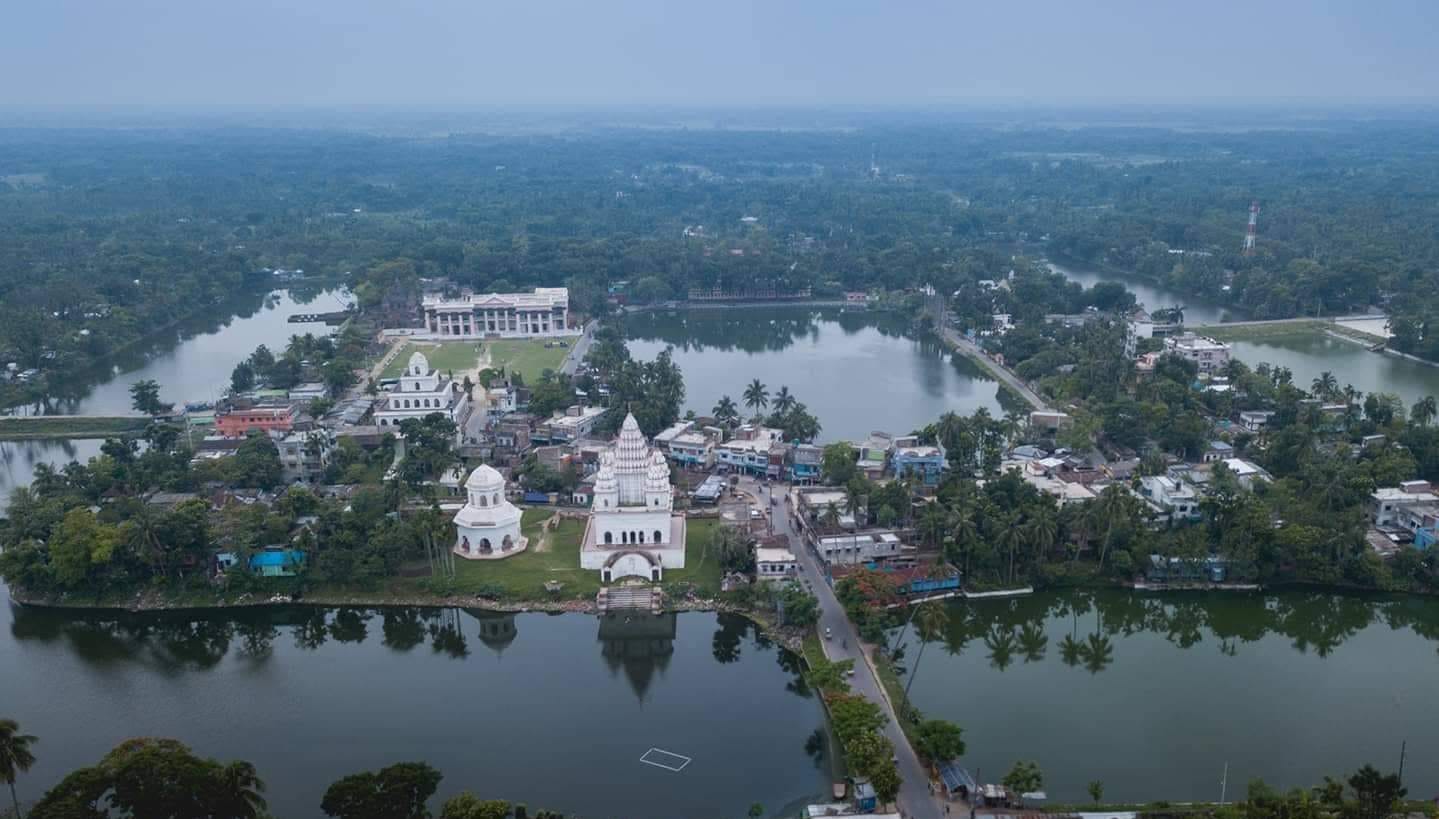
Puthia Temple Complex   Puthia Temple Complex  is a cluster of centuries-old Hindu temples some 23 kilometres to the east of Rajshahi city in Bangladesh. The temples were built by Hindu Zamindars of the Puthia Raj family. They were noted philanthropists and followers of Vaishnavism mainly.  Some 17 large and small temples still exist at Puthia now. The temples are laid out around lakes Shyam Sarobar & Gobind Sarobar with a sprawling lawn.   Puthia Dol Mandir A large four storey structure coated with white plaster towering above the surrounding lakes, bazaar and all other buildings and guards the entrance to the palace precinct. This square shaped fortress like building is actually the largest temple of the Puthia temple complex. Housing ancient black-stone statues of the holy Hindu couple Krishna and Radha.  According to an inscription Dol- Govinda- Mandir was constructed in 1778 by the Panch Ani Raja Vubanendra Narayan.   P...

Ramkeli, Centre of Krishna Bhakti in Malda, Bengal

Image
  Gauda  or Gour, located in the Malda district, presently is a ruined city that served as the capital of Bengal between the 12th and 16th centuries. In the heart of Malda, lies the small village of Ramkeli, popular as the land of Rup and Sanatan, the two great disciples of Sri Chaitanya Mahaprabhu. In the summer of 1515 AD, Sri Chaitanya Mahaprabhu was travelling to Vrindavan and for a short while he had stayed at Ramkeli. Two brothers, Rup and Sanatan Goswami who lived a life of opulence and luxury, were so inspired by His spiritual lessons that they decided to renounce luxury and devote their life to spread the message of Krishna. "Lord Caitanya Mahaprabhu eventually arrived at a village named Ramakeli. This village is situated on the border of Bengal and is very exquisite. While performing sankirtan in Ramakeli-gram, the Lord danced and sometimes lost consciousness due to love of God. While at Ramakeli-gram, an unlimited number of people came to see H...

Click to Know More

Follow on Facebook

Views This Week